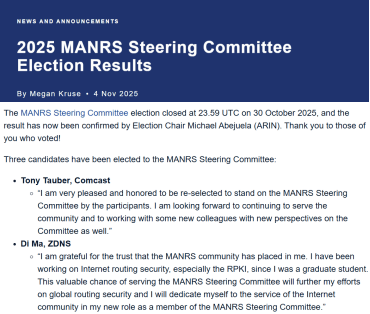
On November 4, the Mutually Agreed Norms for Routing Security (MANRS) initiative—an influential organization within the global network operator community—announced that Ma Di, Chief Researcher at the National Engineering Research Center for Internet Domain Name System (ZDNS), has been elected to its Steering Committee. He is the first Chinese expert to assume this position since the organization’s founding in 2014.
A Core Platform for Internet Governance MANRS, established in 2014 by the Internet Society (ISOC), is an international community initiative dedicated to improving the governance of network operations worldwide. Its mission is to promote the development and implementation of global routing security standards—such as route filtering and IP source address validation—and it has become a central governance platform for ensuring secure and reliable global network interconnection.
Today, MANRS brings together 1,094 telecom operators, 152 Internet exchange points, 33 CDNs and cloud service providers, and 6 network equipment vendors, forming a critical coalition of stakeholders in global routing security.
ZDNS: From Technological Leadership to Meaningful Contributions on the Global Stage
Leveraging its long-standing expertise in foundational Internet technologies and a forward-looking development strategy, ZDNS has continued to advance global cooperation and interconnection while serving the Chinese market. The company drives independent innovation in Internet infrastructure and core technologies, develops next-generation DNS architectures, and invests in building and supporting expert teams that actively contribute to major international Internet governance bodies—including the Internet Corporation for Assigned Names and Numbers (ICANN), the Internet Engineering Task Force (IETF), and the Asia-Pacific Network Information Centre (APNIC).
Within the IETF, ZDNS has led the development of five international standards, including three key RFCs—8211, 8416, and 8897—in the RPKI domain. RFC 8211 became the first technical standard from China to be recognized by the IETF, while RFC 8416 provides a practical, deployable approach to addressing security issues inherent in RPKI itself.
At ICANN, ZDNS has closely followed policy developments related to top-level domains (TLDs) for more than a decade. Feng Shuo, Deputy General Manager of ZDNS, serves as Co-Chair of the ICANN Policy Development Process Working Group on the Next Round of New gTLDs (PDP WG2). At the recently concluded ICANN 84 meeting, it was announced that the second round of new gTLD applications will open from April to August 2026. The ZDNS expert team has been deeply involved in discussions on the policies and rules for this round, helping enterprises and institutions better understand and secure critical Internet infrastructure resources.
At APNIC, Di Ma has been elected—and subsequently re-elected—to the Number Resource Organization Number Council (NRO NC) and the Address Supporting Organization Advisory Council (ASO AC), becoming the first expert from mainland China to serve consecutive terms. He contributes to the global management of IP address allocation and provides policy advice to support the fair and efficient distribution of IPv6 address resources worldwide.
Backed by strong technical capabilities, ZDNS now serves more than 1,200 leading customers across finance, telecommunications, government, education, healthcare, and large enterprises. The company provides end-to-end, systematic solutions for building resilient DNS infrastructures. According to IDC, ZDNS has ranked No. 1 in China’s DDI (DNS, DHCP, and IP address management) market share for ten consecutive years.
From technological innovation to contributions to global standards, and from practical experience to an international perspective, ZDNS remains committed to advancing foundational Internet technologies and building systematic, resilient DNS infrastructures. The company will continue to take an active leadership role in the industry, engage deeply in global Internet technical governance, and integrate its practical solutions into international standards—continuing to contribute to the global Internet governance landscape.