
Start with Business Impact

Ransomware protection should begin with the services the business cannot afford to lose. Which systems support revenue, manufacturing, logistics, healthcare delivery, customer support, payroll, identity, and security operations? Which services must recover first? Which data sets have legal, contractual, or operational importance? Which locations can operate manually, and for how long?
This business impact view helps prioritize technical work. Not every application needs the same recovery time. Not every subnet carries the same risk. Not every device requires the same access. When priorities are clear, network controls can be designed around real business consequences rather than generic security ideals.
Know the Assets Before the Incident
A ransomware response begins poorly if the team does not know what assets exist. Unknown endpoints, unmanaged devices, stale DNS records, undocumented subnets, and unclear address ownership all slow containment. A business does not need perfect inventory before improving ransomware protection, but it does need enough visibility to answer basic questions during an incident.
ZDNS's IPAM capabilities are relevant because IPAM can support address planning, endpoint asset profiles, dynamic address sensing, network device integration, and lifecycle history. During a ransomware event, that data can help responders identify affected address ranges, owners, and services. Combined with DHCP history, it becomes easier to map addresses to devices and network locations.
Use DNS as a Security Signal
DNS is a high-value signal for business ransomware protection. Compromised systems may query suspicious domains before or during attack activity. DNS policy may help block known risky destinations. Resolver logs can show which device attempted a lookup and when. DNS health also matters during recovery because restored services still need names to resolve correctly.
ZDNS's DNS page includes security capabilities such as interception logs, interception alerts, protocol security topics, and recursive resolution control. For business ransomware protection, these features can support early investigation and operational clarity. DNS should be connected to response workflows so suspicious resolution activity can be tied to device identity, subnet, user context, and application ownership.
Control Access to Reduce Blast Radius
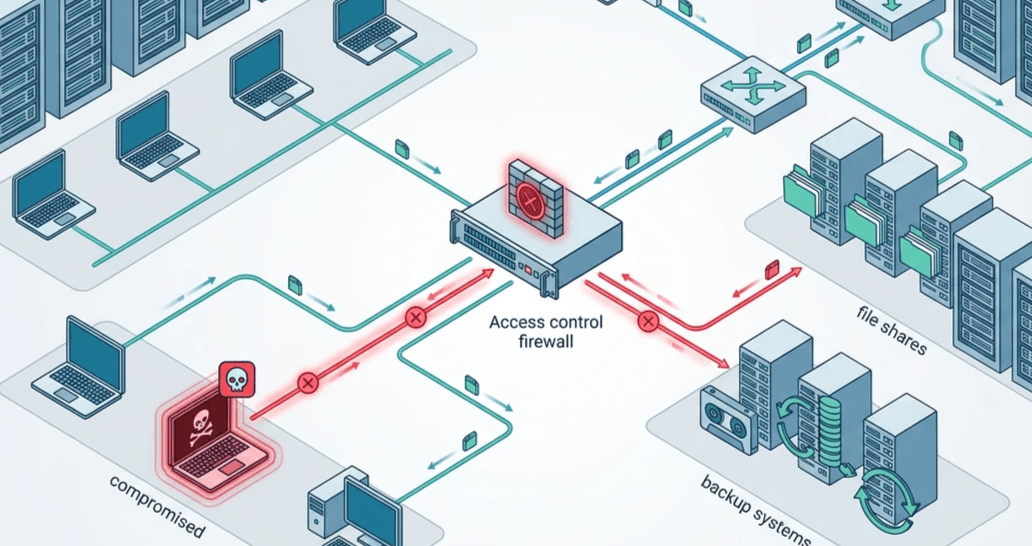
Ransomware becomes more damaging when one compromised endpoint can reach many critical resources. Business protection depends on reducing unnecessary access. Users should not have broad administrative privileges. Workstations should not freely access backup systems. Guest devices should not see internal services. Production systems should not be reachable from every segment.
Network access control helps enforce these boundaries. ZDNS NACS is relevant to device discovery, access control, topology visibility, and unauthorized access prevention. In a ransomware scenario, access visibility helps teams decide what to isolate and what can remain online. It also helps reduce the chance that an unmanaged or risky endpoint becomes a bridge into critical systems.
Protect DNS, DHCP, and IPAM Themselves
Business ransomware protection should include the infrastructure services that make recovery possible. DNS, DHCP, and IPAM are often overlooked because they are assumed to be always available. If they are disrupted, users may be unable to reach restored applications, endpoints may receive wrong network settings, and responders may lose visibility into addresses and owners.
These services should have documented recovery procedures, administrative access controls, configuration backups, monitoring, and change history. Teams should know which DNS zones, DHCP scopes, and IPAM records are critical for restoring business services. Recovery exercises should include these infrastructure dependencies rather than focusing only on application servers.
A Business Ransomware Protection Checklist
The following checklist turns ransomware protection into practical work:
- Identify critical business services, recovery order, and acceptable downtime by function.
- Maintain asset and address visibility across offices, branches, cloud networks, VPN users, and data centers.
- Use DNS policy and resolver logging to observe suspicious domain activity and support investigations.
- Limit lateral movement with segmentation, network access control, and least-privilege connectivity.
- Protect and test backups, including restoration of identity, DNS, DHCP, and application dependencies.
- Review DHCP scopes, resolver settings, and IPAM ownership before major network changes.
- Run tabletop and technical recovery exercises that include security, network, application, and business teams.
This checklist is intentionally cross-functional. Ransomware protection fails when every team assumes another team owns the missing dependency. Business resilience requires shared evidence and shared recovery assumptions.
Backups Need Network-Aware Testing
Backups are central to ransomware recovery, but backup success should be tested in context. Can users authenticate after restoration? Do application names resolve to the restored environment? Do endpoints receive correct network configuration? Are firewall and access rules aligned? Does monitoring confirm that users can reach the service from expected locations?
For applications that operate across sites, DNS and GSLB behavior may be part of recovery. ZDNS GSLB can be relevant to availability planning when DNS-based traffic steering is appropriate. Still, traffic steering is only one piece. The application, data, identity, routing, and access controls must also be ready.
Make Evidence Easy to Use
During an incident, evidence quality matters. A log entry with an IP address is useful only if the team can map it to a device, owner, location, and time. A DNS query is useful only if it can be tied to a client. A blocked access attempt is useful only if responders know whether the device was expected. Business ransomware protection should therefore include evidence design, not only alerting.
Teams should rehearse common evidence paths. Given a suspicious domain, can they identify the querying endpoint? Given an IP address, can they find DHCP lease history and IPAM ownership? Given an unknown device, can they see where it connected and which segment it reached? Given a critical application, can they list its DNS names, addresses, and recovery dependencies? These drills reveal gaps before attackers do.
Governance Keeps Controls Current
Ransomware protection weakens when controls drift. New cloud services appear. Branch networks change. Contractors join. Old DNS records remain. DHCP scopes are copied. Firewall exceptions accumulate. Backup paths change. Governance turns one-time setup into a maintained program. Review cycles should cover asset inventory, privileged access, resolver policy, network segmentation, backup tests, and incident lessons.
NIST's Cybersecurity Framework is useful here because it emphasizes governance, risk management, protection, detection, response, and recovery. Businesses can use that structure to track whether ransomware-related controls are actually improving. The most important measure is not how many tools exist, but whether the organization can reduce impact and recover with confidence.
Where ZDNS Fits
ZDNS fits business ransomware protection as part of the network and DDI control layer. DNS supports resolution visibility and policy. NACS supports device and access visibility. IPAM supports address ownership and lifecycle context. DHCP supports endpoint configuration evidence. GSLB can support availability planning for suitable multi-site services. These capabilities complement, rather than replace, endpoint security, identity protection, backup platforms, and incident response services.
The practical value is coordination. If ransomware protection depends on knowing what is connected, what names are resolved, what addresses are used, and what access is allowed, then DNS, DHCP, IPAM, and access visibility belong in the program from the beginning.
Conclusion
Business ransomware protection is strongest when it is layered, rehearsed, and network-aware. Endpoint controls and backups are vital, but they need DNS evidence, access control, IPAM context, DHCP history, and recovery planning around them. ZDNS can help strengthen that network foundation so businesses can reduce ransomware spread, investigate faster, and restore services with clearer evidence.