
- A second DHCP server is useful only when lease ownership and service configuration remain consistent enough for safe takeover.
- Peer-channel loss is different from confirmed server failure; forcing takeover too early can create split-brain risk.
- Test new allocations, renewals, reservations, relay paths, partner recovery, and resynchronization as separate phases.
- ZDNS DHCP supports dual-node load sharing, automatic lease synchronization, unified configuration management, and automatic fault failover.
Failover is a data-consistency problem before it is a server-count problem.
DHCP failover depends on more than having a second server powered on. The peers must share a sufficiently current understanding of which addresses are free, offered, active, expired, released, or otherwise unavailable. Without trustworthy lease synchronization, both servers can make decisions from different realities. The result may be reduced capacity, failed renewals, stale ownership, or duplicate allocation when a server takes over.
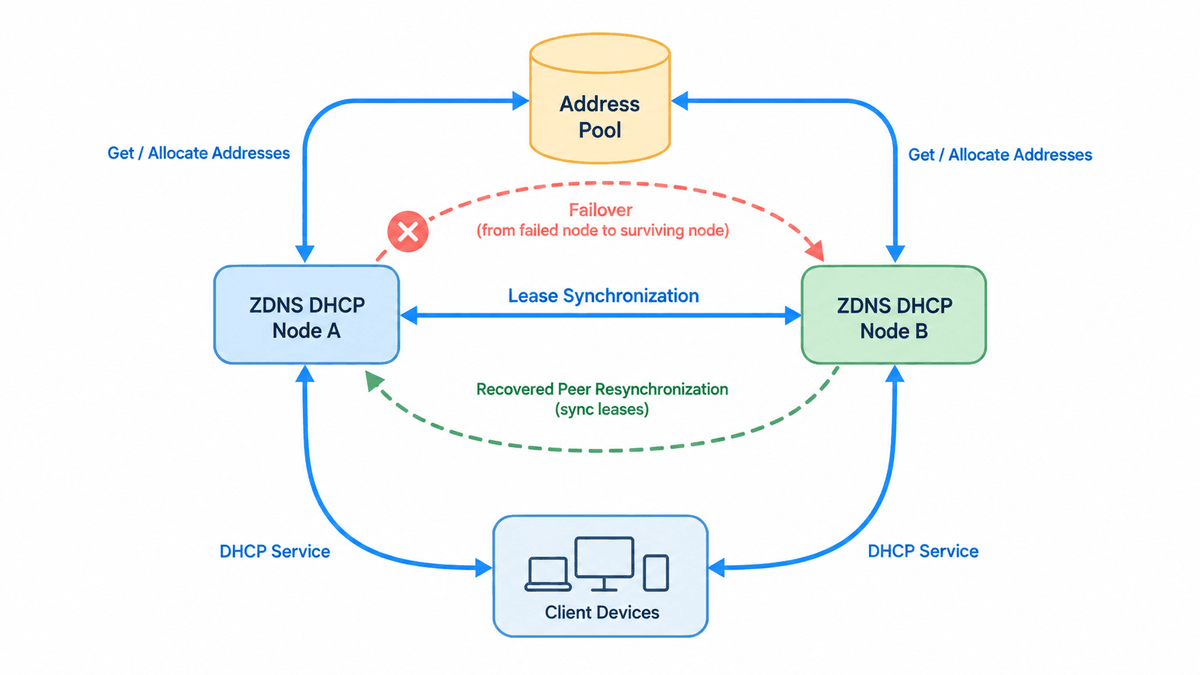
ZDNS DHCP places automatic lease synchronization alongside dual-node load sharing, unified configuration management, HA mechanisms, and automatic fault failover. Those capabilities address the operational purpose of a failover pair: keep address allocation available while preserving lease consistency. ZDNS IPAM adds utilization and lifecycle visibility so teams can validate service behavior before, during, and after a peer failure rather than treating a green server status as sufficient evidence.
Why Does Failover Depend on Current Lease State?
A DHCP lease is a time-bound agreement between a client and a server. The server records the client identity, address, start time, expiration, and related state. In a failover design, the partner needs enough of that information to renew an existing client or allocate a different address safely when responsibility changes. Configuration symmetry alone cannot provide that knowledge. Two servers can have identical scopes and options while holding different lease databases.
Synchronization protects both continuity and uniqueness. During a failure, the surviving peer must know which addresses are already in use so it does not reassign them. It also needs access to free capacity so new devices can connect. When the failed node returns, it must recover current state before resuming normal allocation. A rushed return with stale lease data can undermine the protection that the failover design was meant to provide.
What Must DHCP Failover Peers Keep Consistent?
Lease state is central, but the operating relationship also depends on compatible scope definitions, pools, reservations, options, timers, and peer settings. A scope present on only one node is not protected. A reservation or exclusion changed on one peer but not the other can alter what each server considers assignable. Time differences complicate expiration decisions and log correlation. Network paths between peers must allow synchronization traffic reliably enough for the chosen design.
Create an explicit baseline for every protected scope. Record the two peer identities, service mode, address pools, option versions, expected synchronization state, and monitoring ownership. ZDNS unified configuration management reduces manual divergence, while automatic lease synchronization maintains changing allocation state. Transaction logs and address visibility should make it possible to compare what each node observed during a test or incident.
- Protected scopes, pools, reservations, exclusions, and options
- Peer role and expected load-sharing or standby behavior
- Active lease identity, address, and expiration state
- Configuration version and deployment status
- Clock synchronization and event timestamps
- Peer communication path, latency, loss, and monitoring alerts
What Should Happen During Normal Failover Operation?
In normal operation, a client request is handled according to the pair's service mode. One peer allocates or renews the address, then the lease state becomes available to the partner. In a load-sharing arrangement, both nodes may serve clients while coordinating address ownership. In a standby arrangement, one node serves normal traffic while the other remains ready. The implementation details vary, so the operational test should focus on outcomes supported by the deployed ZDNS configuration rather than assuming behavior from another vendor's terminology.
Monitor synchronization during ordinary demand before testing failure. Confirm that new leases, renewals, releases, reservations, and expirations appear as expected. Compare pool free counts and check for a growing backlog or repeated peer communication errors. A failover pair that is already inconsistent during normal operation should not be trusted during an outage. Resolve the underlying path, configuration, or data problem first.
What Changes When Peer Communication Is Interrupted?
Loss of the peer channel is not the same as confirmed server failure. Each node may still be serving clients, and both must avoid allocating the same address. Failover protocols therefore limit how a server uses addresses when it cannot determine the partner's condition. Available capacity and lease duration can change during this state. Operators should know the platform's state model, how transitions occur, and which action requires human confirmation.
Do not force an active node into a full-takeover condition merely because a monitoring check failed. First establish whether the partner is actually down or only unreachable from one path. A split-brain decision can permit both nodes to act with expanded authority. ZDNS automatic fault failover should be tested under the exact network architecture in use, including link failure, process failure, appliance failure, and loss of communication between otherwise healthy peers.
How Does ZDNS DHCP Support Synchronized Availability?
ZDNS DHCP combines dual-node load sharing with automatic lease synchronization and automatic fault failover. Unified configuration management helps keep service definitions aligned, while real-time and historical IP information, address-pool utilization, assigned-address visibility, and transaction logs give operations evidence of what happened. After takeover, a query through ZDNS DNS can help verify that clients received usable resolver settings as well as valid addresses. The value is not simply redundancy. It is a coordinated pair that can continue allocating addresses without losing sight of current lease ownership.
Keep product claims within the tested deployment. The ZDNS product page describes automatic failover with no endpoint impact, but buyers should still validate their own relay, switching, routing, authentication, and client behavior. A DHCP pair cannot preserve connectivity if requests never reach the surviving node or if dependent network paths fail. End-to-end acceptance testing turns the product capability into a supportable service design.
Which Failover States Need Different Operator Decisions?
| Condition | What is known | Safe operator focus |
|---|---|---|
| Normal | Peers communicate and exchange lease state | Watch update age, pool balance, and configuration version |
| Peer communication interrupted | The partner may still be serving clients | Diagnose the peer path before expanding authority |
| Confirmed partner failure | One node cannot serve clients | Follow the tested takeover procedure and monitor usable capacity |
| Recovering peer | Returned node may hold stale lease data | Complete resynchronization before normal allocation resumes |
| Post-recovery | Both nodes have returned to service | Compare sample leases, logs, options, and pool counts |
Microsoft describes a failover relationship as a pair of two DHCP servers and documents hot-standby and load-balance modes for DHCPv4. The Microsoft protocol overview explains that the partner database must be synchronized so another server can renew a lease safely. ZDNS publishes support for dual-node load sharing, automatic lease synchronization, automatic fault failover, and cluster-level scalability for millions of addresses.
How Should You Test Takeover, Renewal, and Recovery?
A useful test begins with known clients and recorded lease state. Include an existing client near renewal, a new client with no lease, a reserved device, and a client on a remote relay. Capture which peer serves each request and the resulting address. Then stop or isolate one node according to the approved test procedure. Verify that existing clients renew, new clients receive nonconflicting addresses, options remain correct, and pool capacity behaves as expected.
Recovery is a separate test phase. Bring the peer back only through the supported process and confirm that it synchronizes current state before resuming allocation. Compare lease counts, selected sample records, configuration versions, and logs. Test another renewal after the pair returns to normal. The exercise should produce a clear timeline: last successful synchronization, failure detection, service takeover, leases issued during the event, peer recovery, resynchronization, and return to normal operation.
What Happens When a Campus Node Fails at Peak Login?
A campus DHCP pair supports residence halls and classrooms. One node fails during the morning arrival peak, when many laptops and phones request addresses at once. The surviving ZDNS DHCP node continues service through the configured failover mechanism. Operators check new allocations, renewal success, free-address counts, and transaction logs instead of relying only on appliance status. Remote VLANs are included because relay reachability can differ from the local data-center path.
When the failed node returns, it is not allowed to allocate immediately from stale data. The team verifies lease synchronization and samples addresses issued during the outage before restoring normal pair operation. IPAM utilization and history provide an independent view of the affected scopes. The expected outcome is uninterrupted or minimally affected onboarding with no duplicate allocations and a complete operational record of the transition.
What Happens When a WAN Partition Separates Healthy Peers?
Two DHCP peers are placed in separate sites to survive a data-center outage. A WAN partition interrupts peer communication, but both appliances and local client networks remain active. This is more complex than a simple server crash because each side may believe the partner is unavailable. The team observes the platform's communication-interrupted behavior and avoids forcing both nodes into a state that could allow conflicting use of the shared pool.
The design is revised so monitoring distinguishes peer-channel loss from appliance failure, and the escalation procedure names who can authorize a state change. Pool capacity is sized for the constrained period, and the test checks local renewals on both sides. When connectivity returns, ZDNS lease synchronization and logs help confirm that the pair converges safely. The scenario validates the network around the DHCP service, not only the servers themselves.
Which Checks Prove Lease Synchronization Is Healthy?
- Verify every critical scope is assigned to the intended pair.
- Compare configuration versions and effective options on both peers.
- Monitor the age of the last successful lease update.
- Alert on peer-channel loss, synchronization backlog, and pool imbalance.
- Test existing renewals, new allocations, reservations, and remote relays.
- Confirm the surviving node has enough usable capacity for the failure window.
- Require resynchronization before a recovered peer resumes allocation.
- Retain transaction and IP history for post-event comparison.
DHCP failover lease synchronization is the mechanism that turns a spare server into a trustworthy service partner. A resilient design keeps configuration aligned, lease ownership current, failure states observable, and recovery deliberate. ZDNS provides synchronized, high-availability DHCP capabilities and the visibility needed to test those outcomes across real enterprise networks. The final proof is not that two nodes exist; it is that clients retain correct addressing through failure and recovery without conflicting leases.
What Do Network Teams Ask About Lease Synchronization?
Does DHCP failover copy both leases and configuration?
That depends on the implementation and change process. Lease-state synchronization and configuration replication are related but distinct. A pair can share current leases while scopes, options, reservations, or exclusions drift after an unreplicated change. Validate both the changing lease database and the effective service configuration on each peer.
Why can a failover pair show different free-address counts?
Small temporary differences may reflect update timing or pool ownership, but a growing or persistent gap needs investigation. Compare the same scope, timestamps, partner state, pending updates, and recent allocations. Also check whether both nodes received the latest configuration. A green service status does not prove that their allocation views agree.
What is the difference between peer loss and server failure?
Peer loss means the servers cannot communicate; it does not prove either server stopped serving clients. Both sides may still reach their local networks. Server failure means one node cannot provide service. The distinction matters because granting full pool authority during a partition can let two healthy nodes make conflicting allocation decisions.
Should a recovered DHCP peer serve clients immediately?
No. It should follow the product's supported recovery process and obtain current lease state before resuming normal allocation. A node returning with stale data may treat an in-use address as free. Compare synchronization status, configuration version, lease samples, and transaction logs before declaring the pair healthy again.
How often should DHCP failover be tested?
Test after architecture changes, upgrades, relay changes, recovery-procedure updates, and on a regular resilience schedule. Include an existing renewal, a new client, a reservation, and a remote relayed subnet. Record failure detection, takeover, allocations issued during the event, resynchronization, and return to normal service.