
Start by Naming the Failure Type
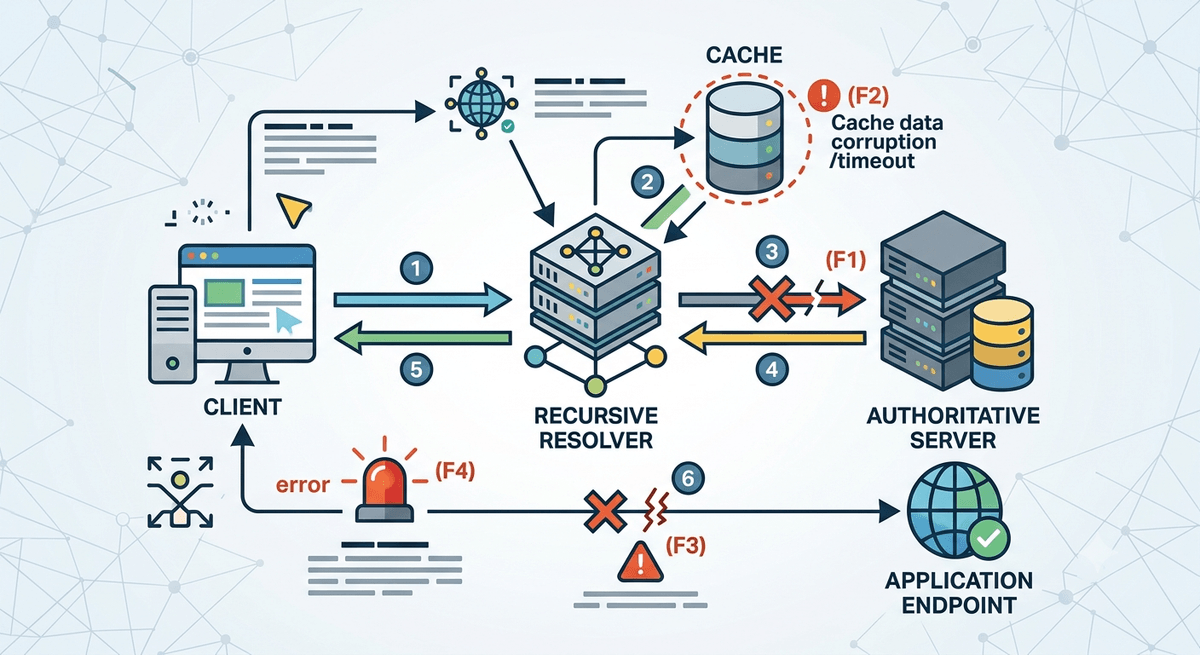
"DNS is down" is too broad to be useful. A better incident note captures the domain, client location, configured resolver, response code, answer, latency, and timestamp. If the response is NXDOMAIN, the name may not exist in the queried view. If the response is NODATA, the name may exist but not for the requested record type. If the response is SERVFAIL, the resolver may have hit an upstream issue, validation problem, or server-side error. If there is no response, reachability and firewall behavior move higher on the suspect list.
Those distinctions matter because the corrective action changes. Creating a missing record will not fix a resolver that cannot reach upstream servers. Restarting a resolver will not fix a bad delegation. Changing DHCP options will not correct an expired authoritative record. DNS failure triage should prevent the team from applying a familiar fix to the wrong layer.
Resolver Failure and Authoritative Failure Are Different
Recursive resolvers and authoritative servers play different roles. The recursive resolver receives client queries and performs the lookup work on the client's behalf. Authoritative servers publish zone data for a domain. When a user reports failure, the team should identify whether the recursive path failed, whether authoritative data is wrong or unreachable, or whether the client is querying the wrong resolver for the name.
This distinction becomes especially important in split-view environments. Internal users, external users, VPN clients, cloud workloads, and partners may receive different answers for the same name. A public resolver returning NXDOMAIN may be correct for an internal-only service. A VPN user receiving a public answer may indicate that resolver assignment or conditional forwarding is wrong. The same domain can therefore be healthy from one location and broken from another.
Use DDI Context Before Changing Records
DNS failures often begin outside DNS. A branch subnet may receive the wrong resolver through DHCP. A cloud migration may leave IPAM ownership data behind. A service owner may reuse an address before DNS records are updated. A firewall object may follow an old address assignment. If DNS is changed without checking address and scope context, the team can make the incident harder to unwind.
DDI context helps answer three questions quickly: Which clients were supposed to use this resolver? Which service owns the address returned by this record? Which DHCP scope, subnet, or address plan changed before the failure began? ZDNS positions DNS, DHCP, and IPAM as connected product areas, which is useful for teams that want incident evidence to move across these layers instead of living in separate tools.
Cache Behavior Can Extend an Outage
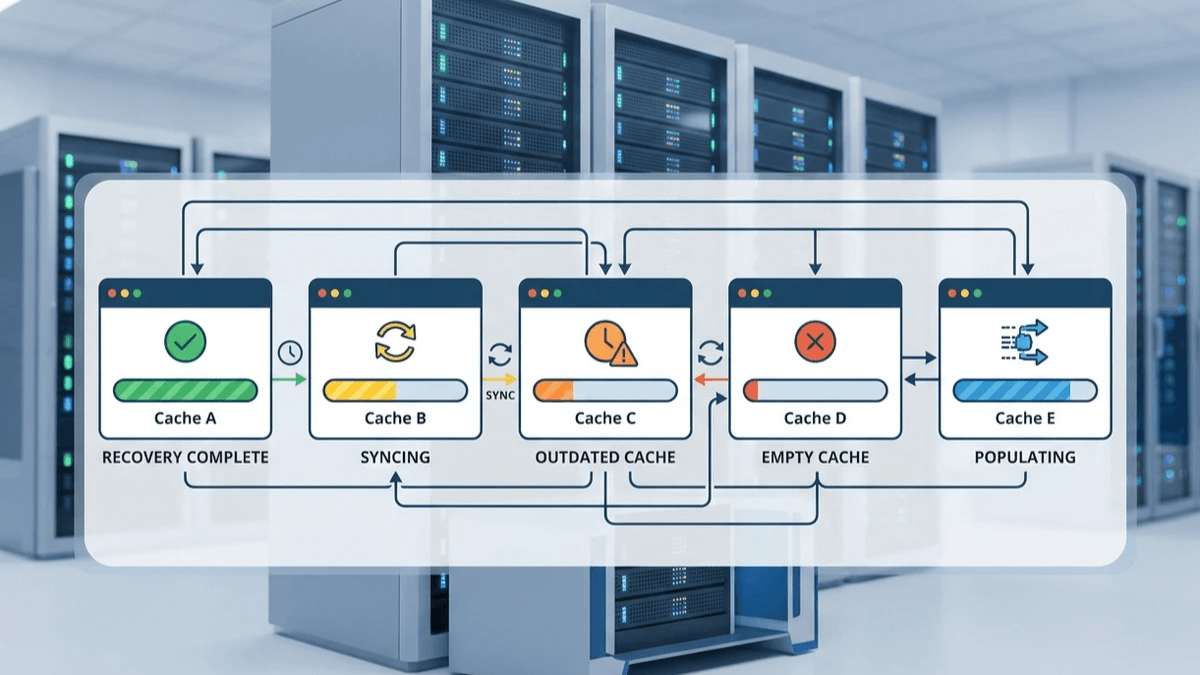
DNS caching is helpful until a bad answer is cached. A record with a long TTL may keep directing clients to an old endpoint. A negative response may persist for a time after a missing record is corrected. Some intermediate resolvers may have different cache state, so one user group may recover earlier than another. In high-pressure incidents, this can create the impression that the fix failed even when authoritative data is now correct.
Teams should treat cache behavior as part of the incident timeline. Record the TTL before emergency changes. Query multiple recursive resolvers. Test authoritative answers directly when possible. Avoid lowering TTL only after a bad record has already been cached and expecting immediate global recovery. For planned migrations, lower TTLs ahead of the change window when operationally appropriate, then raise them after stability is confirmed.
A DNS Failure Triage Runbook
A short runbook keeps responders from skipping evidence under pressure:
- Capture the exact user symptom, domain name, device location, network path, and time.
- Check the configured resolver on an affected client and compare it with the expected resolver for that subnet or VPN profile.
- Query the configured recursive resolver and record response code, answer, latency, and TTL.
- Query an authoritative source or trusted diagnostic resolver to compare recursive and authoritative behavior.
- Review DHCP scope options, recent DNS changes, IPAM ownership, and firewall or routing changes.
- Identify whether a security policy intentionally blocked or redirected the query.
- Document the final failure class so repeated incidents can be grouped later.
The final step is easy to skip, but it matters. If the team only records "DNS fixed," leadership cannot see whether the organization has a recurring resolver capacity issue, a change-control issue, a split-view design issue, or a DHCP template issue.
Security Policy Can Look Like Failure
Protective DNS, domain filtering, and resolver policy can intentionally block answers. That is useful when it prevents access to risky infrastructure. It becomes disruptive when support teams cannot distinguish an intentional policy result from an infrastructure fault. Security operations and network operations should agree on what blocked responses look like, where policy logs live, and how service desk teams can verify a block.
For organizations connecting DNS behavior with device and access posture, ZDNS NACS can be part of a wider access-control conversation. DNS evidence is stronger when it can be associated with device identity, network segment, and access state.
Failure Recovery Needs a Return Path
DNS recovery is not complete when the first successful query appears. Teams should confirm that the answer is correct from relevant locations, that caches are converging, that monitoring has returned to normal, and that temporary emergency changes are removed or formally accepted. If traffic was shifted to a secondary site, failback needs the same care as failover.
For services that use DNS-based steering, ZDNS GSLB can support availability planning when health checks and policy are designed carefully. The DNS layer can help direct users, but the application and network path must also be healthy. Recovery should include application confirmation, resolver confirmation, and address-management confirmation.
Turning Incidents into Reliability Work
Recurring DNS failure is usually a signal that the operating model needs attention. Common improvement areas include resolver capacity, resolver assignment standards, split-view governance, CNAME chain review, authoritative change approval, DHCP scope templates, IPAM ownership quality, and monitoring coverage. The goal is not to make every incident a large program. The goal is to convert repeated evidence into small operational fixes.
A useful post-incident review asks whether the failure was detected by monitoring before users reported it, whether the team knew which resolver served the affected clients, whether address ownership was clear, whether the fix required manual coordination across too many systems, and whether the same symptom has happened before. These questions help DNS operations become more predictable over time.
Conclusion
DNS failure response improves when teams classify the failure before fixing it. Identify the response type, separate recursive and authoritative behavior, check DDI context, account for cache timing, and document the final failure class. With DNS, DHCP, IPAM, and availability planning treated as connected work, DNS failure becomes easier to diagnose and less likely to repeat.