
The Path Behind a Single Query
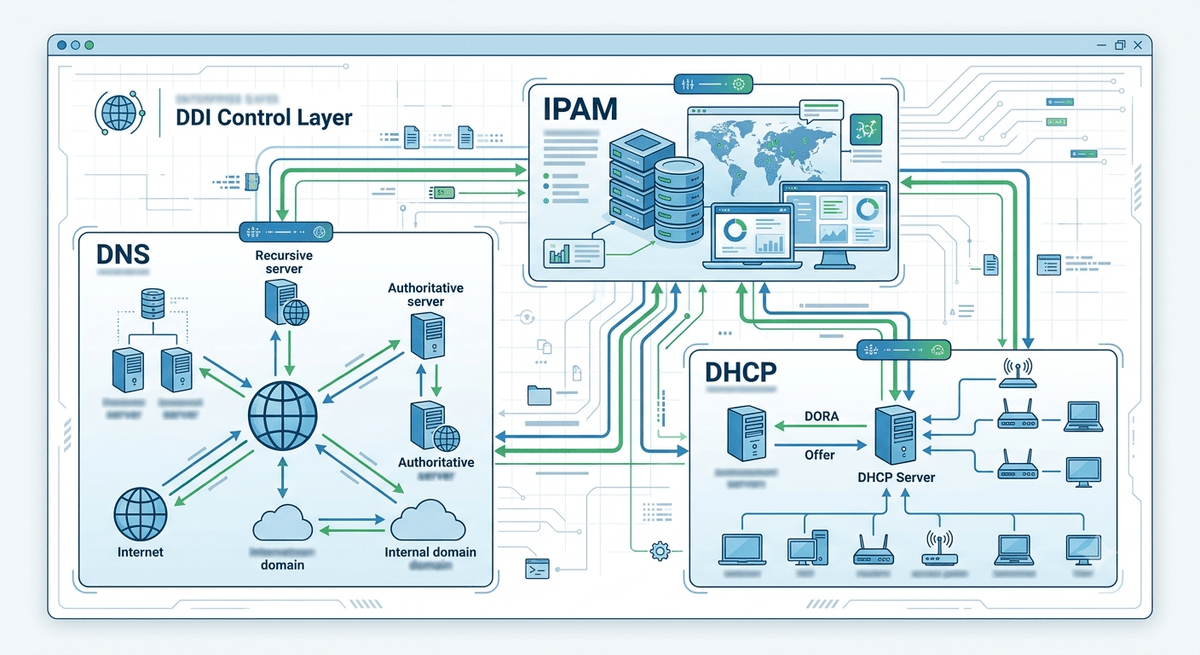
A DNS query often begins with a stub resolver on the endpoint. The endpoint asks a configured recursive resolver for an answer. If the resolver does not already have a usable cached response, it follows the DNS hierarchy, queries authoritative sources as needed, caches the result according to TTL rules, and returns an answer to the client. That answer may be an address record, a CNAME chain, an error code, or a policy-based response.
For infrastructure teams, the important point is that each step can affect user experience. The endpoint may have the wrong resolver. The recursive resolver may forward to an unhealthy upstream server. The authoritative data may be stale. A CNAME chain may point outside the intended control boundary. A security policy may block the answer intentionally. A short TTL may increase query load, while a long TTL may slow recovery from change. DNS resolution is therefore a workflow, not a single lookup.
Resolution Quality Is More Than Speed
Low latency matters, but fast answers are not enough. Resolution quality also includes accuracy, consistency, visibility, policy enforcement, and recoverability. If a branch office receives an answer that points to a distant application region, users may experience latency even though DNS answered quickly. If VPN users resolve an internal name through a public resolver, the response may be technically valid but operationally wrong. If a security team cannot see which clients queried a suspicious domain, the resolver is leaving risk intelligence on the floor.
Good DNS resolution design asks practical questions: Which resolvers serve each user group? Which views apply to internal, external, cloud, VPN, and partner networks? Which names require special routing or traffic steering? Which records are tied to high-priority applications? Which resolver logs are retained and searchable during an incident? These questions turn DNS from a reactive troubleshooting topic into a managed service.
Where DDI Enters the Picture

DNS, DHCP, and IPAM are tightly connected. DHCP often tells endpoints which resolvers to use. DNS maps names to services and addresses. IPAM records the intended ownership and lifecycle of address space. When these systems are managed separately, teams may fix the wrong layer. A DNS complaint may begin with a DHCP scope that distributed an outdated resolver. A record update may point to an address that IPAM still shows as reserved for another service. An IPv6 rollout may create AAAA records before the routing and firewall path is ready.
A DDI operating model reduces those gaps. ZDNS's product areas for DNS, DHCP, and IPAM support the idea that resolver behavior, address assignment, and address governance should be understood together. That does not mean every DNS issue is caused by DHCP or IPAM. It means the team should be able to check those relationships quickly before making a risky record change.
Resolution Controls Worth Standardizing
Enterprise teams should standardize the controls that shape resolution behavior. The following checklist is a useful starting point:
- Resolver assignment rules for office, branch, VPN, cloud, guest, and privileged networks.
- Forwarding policies for internal zones, external names, cloud domains, and regulated workloads.
- TTL standards for stable infrastructure, fast-changing services, failover records, and migration windows.
- Logging requirements for resolver health, response codes, latency, blocked domains, and policy actions.
- Change review steps for CNAME chains, split-view records, IPv6 records, and ownership changes.
- Monitoring from user-relevant locations rather than only from a data center resolver.
These controls help operations teams avoid one-off resolver exceptions that become invisible dependencies. They also make it easier to automate changes because the rules are explicit enough for workflow tools and APIs to enforce.
Cache Behavior Can Help or Hurt
DNS caching is essential to scale. Without caching, resolvers and authoritative servers would face unnecessary load, and users would wait longer for repeated answers. But caching also creates timing behavior that teams must understand. A bad answer can remain visible until cache entries expire. A planned migration may appear complete for one resolver and incomplete for another. Negative responses, such as NXDOMAIN or NODATA, may also be cached depending on authoritative data and resolver behavior.
For production changes, the safest approach is to plan around cache behavior before the change begins. Lower TTLs ahead of a planned cutover when appropriate, validate that authoritative data is correct, and monitor recursive resolvers from multiple locations. After the change, avoid assuming that one successful query proves all users are seeing the new path. Resolution state is distributed, and distributed systems need observation from more than one vantage point.
Security Visibility Starts with the Resolver
DNS resolution is often one of the earliest signals of application misuse, malware activity, data exfiltration attempts, or misconfigured services. A client may query an unusual domain before any connection is established. Resolver logs can help security teams connect domain names, client subnets, device identities, and timestamps. If DNS resolution is bypassed or fragmented across unmanaged resolvers, that signal becomes incomplete.
Security policy should be designed so users understand the difference between an infrastructure failure and an intentional block. A blocked domain should leave enough evidence for support and security teams to explain what happened. For environments that connect endpoint visibility and access policy, ZDNS NACS can fit the wider conversation about device visibility and access governance.
Resolution and Application Resilience
DNS resolution also plays a role in resilience. Applications increasingly run across multiple sites, clouds, or regions. DNS and GSLB can help users reach an available destination, but the resolver path has to support the desired behavior. Health checks need to represent real application availability. TTL values need to match recovery objectives. Users in different regions may require different answers. Monitoring should verify what users actually receive, not only what the authoritative zone contains.
For traffic steering and multi-site availability scenarios, ZDNS GSLB is relevant because DNS-based decisions often sit in front of application recovery. Still, DNS cannot repair an unhealthy backend by itself. The application, network path, address plan, security policy, and failback procedure all need to be ready.
Preparing Resolution for IPv6
IPv6 adoption changes DNS resolution in practical ways. Users may receive A and AAAA records. Operating systems may choose between IPv4 and IPv6 paths. Firewalls, monitoring, and IPAM records must understand both address families. If IPv6 is only partially implemented, DNS can expose the gap: a client receives an IPv6 answer, attempts that path first, and experiences delay or failure before falling back.
IPv6-aware resolution requires coordination among DNS records, DHCPv6 or router advertisement behavior, address planning, security rules, and application testing. ZDNS's IPAM capabilities are especially relevant when teams need a clear model for IPv6 address space, ownership, scanning, and lifecycle history. Without that context, adding AAAA records can outrun operational readiness.
Conclusion
DNS resolution is a decision layer for modern enterprise networks. It affects where users connect, how applications recover, what security teams can observe, and how confidently infrastructure teams can change services. A mature approach treats resolution as part of DDI operations: resolver policy, DHCP configuration, IPAM data, monitoring, and change control all need to tell the same story. When they do, DNS becomes a source of operational clarity rather than a recurring mystery.