
The DHCP renewal process is designed to extend a client's address lease before the lease expires. Most renewals are quiet. The client already has an address, knows the server that granted it, and can usually request an extension without repeating the entire initial discovery exchange. That quiet success is useful for users, but it can also allow developing DHCP problems to remain unnoticed until many clients reach later states.
Network teams should therefore understand renewal as a state machine and a source of operational signals. A DHCPREQUEST at T1, a delayed DHCPACK, a transition to rebinding, and an unexpected DHCPNAK each tell a different story. When those events are visible in logs and correlated with scopes, relays, HA peers, DNS, and IPAM, teams can act before lease expiration becomes a connectivity incident.
ZDNS describes DHCP failover and lease synchronization, real-time and historical address information, transaction logs, pool utilization, and endpoint fingerprint visibility. Those capabilities support an operations model in which renewal health can be measured instead of inferred from user complaints.
Renewal Begins with the Original DHCPACK
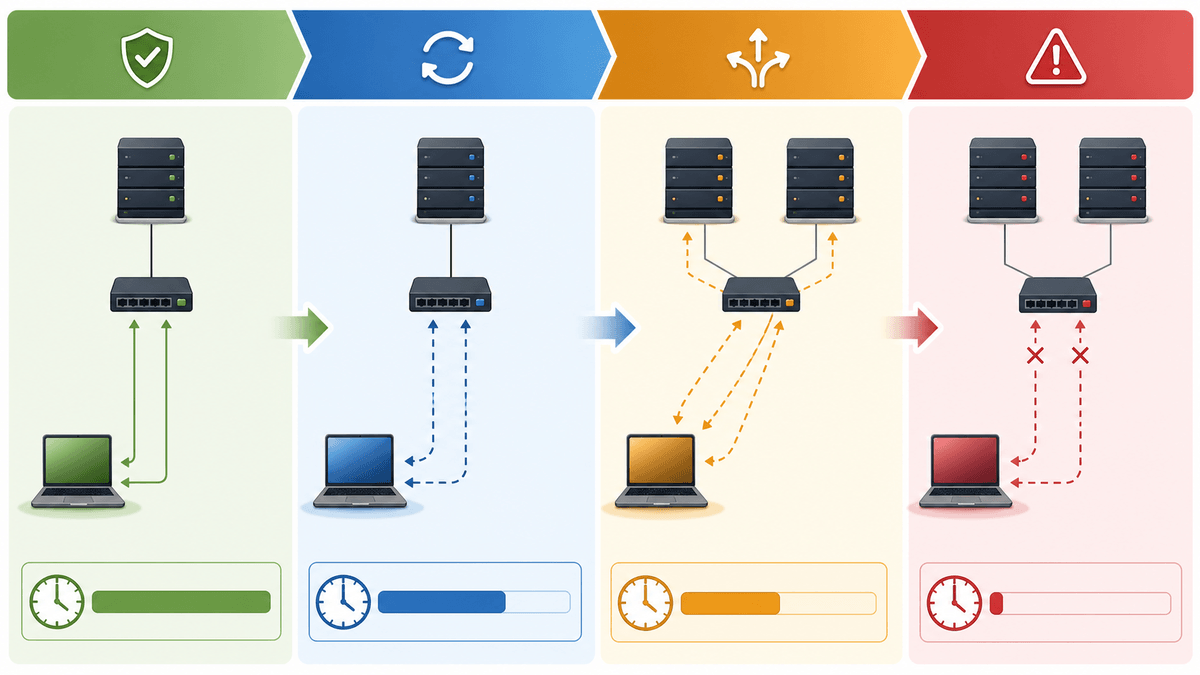
The renewal timeline is established when the client accepts a lease. During initial address acquisition, DHCPv4 normally follows Discover, Offer, Request, and Acknowledge. The DHCPACK confirms the assigned address and configuration. It can also carry the lease duration, renewal time value, and rebinding time value.
After recording the lease, the client enters the BOUND state and uses the address. The lease is temporary even though nothing appears to be happening. Timers count down in the background. RFC 2131 calls the renewal timer T1 and the rebinding timer T2.
If the server does not provide explicit timer values, RFC 2131 defines defaults relative to the lease: T1 at 50 percent and T2 at 87.5 percent. Servers can configure other values, and clients may introduce small timing variation. The effective values in a specific exchange are better evidence than assumptions based on the defaults.
The BOUND State Is the Baseline
While BOUND, the client has valid configuration and normally communicates without DHCP traffic. This is the best time to establish the baseline for troubleshooting: assigned IP address, subnet mask, default gateway, DNS servers, DHCP server identifier, lease start, lease expiration, T1, and T2.
On the server, the matching lease should show the same client identity and address. The scope should have sufficient free capacity, the relay path should be known, and HA peers should agree on state. This baseline matters because a later renewal failure can originate in several places: the client, local network, relay, server, policy, synchronization channel, or return path.
A monitoring platform should distinguish the absence of DHCP traffic from the absence of service. A stable population with successful long leases can generate relatively few exchanges. Renewal success rates, latency, and state transitions are more meaningful than raw packet volume alone.
At T1 the Client Enters RENEWING
When T1 arrives, the client enters the RENEWING state. It sends a DHCPREQUEST intended for the server that granted the lease. Because the client already has a usable address and server identity, this request can normally be unicast rather than broadcast.
The request asks to continue using the address. A healthy server checks the lease and policy, extends it when appropriate, and returns a DHCPACK. The acknowledgment can refresh the lease duration and other DHCP options. The client records the new values and returns to BOUND.
From an operations perspective, the key evidence is not simply that packets exist. Verify the server identifier, client identifier, requested or current address, relay context when applicable, response time, and option values. A rapid request-acknowledgment pair with consistent policy is the normal pattern.
A DHCPACK Resets More Than the Expiration Clock

A successful DHCPACK can carry updated configuration, not only a longer lease. DNS server addresses, domain search information, routes, vendor options, and other policy can change. Teams that alter DHCP options should understand when existing clients will renew and whether endpoints apply the new values immediately.
The server should update its lease state and synchronize it according to the HA design. Logging should preserve the client, address, scope, server, and transaction time. IP address lifecycle management can reflect the continued assignment and retain the historical context needed for later investigation.
Dynamic DNS may also be involved. Depending on policy, the client or DHCP service can update DNS when a lease is granted or changed. Renewal does not automatically mean every DNS record must be rewritten, but the ownership and aging design should keep name records aligned with current address use. ZDNS DHCP supports DDNS updates into DNS, connecting dynamic allocation with managed DNS operations.
No Reply at T1 Is a Warning, Not Immediate Failure
If the client does not receive a DHCPACK at T1, it does not immediately abandon the address. The lease remains valid, and the client retries according to its implementation while moving toward T2. Users may see no symptom during this period.
This silent interval is the best opportunity for monitoring to catch a problem. A rise in unanswered renewal requests can indicate a failed server interface, lost route, blocked UDP traffic, relay issue, overloaded service, or incorrect HA state. Because clients still have valid leases, operations teams have time to diagnose the path.
Look for concentration. Are failures limited to one VLAN, branch, relay, server, client type, or time window? Does the request reach the server? Does the server log a response? Is the response visible on the client segment? A missing request and a missing response are different faults.
At T2 the Client Enters REBINDING
When T2 arrives without a successful renewal, the client enters the REBINDING state. It broadcasts a DHCPREQUEST because the original server may be unavailable. An appropriate DHCP server that can extend the lease may respond.
Rebinding is a resilience mechanism. It allows another server to help before expiration, provided the service architecture has the necessary lease knowledge and authority. In an HA design, peer state and lease synchronization become critical. A responding server must not create conflicting ownership or extend a lease based on stale information.
A growing rebind rate is an important health indicator even when clients ultimately succeed. It means normal renewal to the original server is failing. Treat repeated rebinding as degraded service rather than celebrating that expiration was avoided.
A DHCPNAK Changes the Path Immediately
A DHCPNAK tells the client that its current network configuration is not valid for the responding server's view. The client must stop using the address and return to initialization. This can occur when a device moves to another network, the address is no longer appropriate, or server policy rejects the requested configuration.
Unexpected NAKs deserve careful correlation. Confirm the responding server is authorized, the client is on the expected segment, the relay supplied correct information, and overlapping scopes are not active. A rogue DHCP server or misconfigured helper can generate responses that disrupt legitimate clients.
ZDNS DHCP lists rogue-server detection, pre-allocation checks, illegal protocol filtering, and access controls among its process-reliability capabilities. These controls are relevant when teams need to distinguish a valid policy correction from an unauthorized response.
Expiration Is the End of Permission to Use the Address
If the client reaches lease expiration without an extension, it must stop using the leased address. It can begin a new acquisition process, but continued use of the expired address risks conflict if the server has made the address available to another client.
The visible effect depends on the endpoint and application. Existing sessions may fail, new connections may not start, and an operating system may show limited or no network access. A client might obtain the same address again or receive a different one. Either result should be reflected in lease history and, where appropriate, DNS.
Operations teams should avoid waiting for this terminal event. Monitoring unanswered renewals and rebind transitions provides earlier and more specific evidence than a help-desk report that "the network dropped."
High Availability Changes the Failure Questions
DHCP HA is not simply two servers with the same scope configured manually. The peers need a defined service relationship, consistent configuration, synchronized lease knowledge, and predictable behavior during communication or node failure.
ZDNS describes dual-node load sharing, unified configuration management, automatic lease synchronization, and failover. In such an architecture, monitor both client-facing service and the peer relationship. A server can respond to clients while lease synchronization is degraded, creating risk that becomes visible only during failover.
Useful HA checks include:
- Peer communication state and synchronization delay.
- Lease ownership consistency for active and recently changed records.
- Renewal success by serving node and network segment.
- Behavior when one node, interface, or site is unavailable.
- Scope utilization and reserve capacity during degraded service.
- Configuration consistency for lease timers and options.
Build Renewal Health from Several Signals
No single metric proves DHCP health. A dashboard should combine successful renewals, unanswered requests, rebind rates, NAK rates, server response latency, pool utilization, declined addresses, HA state, and relay reachability. Baselines should be segmented by scope and network role because guest wireless, office workstations, VPNs, labs, and infrastructure can have different lease behavior.
Transaction logs provide the timeline. Pool and assignment views show whether capacity contributes to the problem. Endpoint fingerprint attributes can reveal whether failures correlate with one device class. Historical IP data shows whether addresses were reassigned or held unexpectedly.
For security and incident response, combine DHCP evidence with IPAM and endpoint access visibility. The question is not only whether a renewal succeeded. It may also be which device held the address, where it connected, and whether it was authorized at that moment.
A Safe Renewal Test Plan
Test renewal behavior in a representative but controlled segment. Use an endpoint that can be disconnected without affecting production. Capture client and server timestamps, DHCP messages, lease records, and HA state. Confirm the normal T1 renewal first.
Then test one failure at a time. Examples include making the original server temporarily unreachable while keeping the peer available, blocking the test path in an isolated lab, or changing an approved option and observing when it reaches the client. Do not combine failures until the baseline behavior is understood.
Define success before the test: expected state transitions, maximum response time, permitted address continuity, server log entries, peer synchronization, DNS behavior, and recovery steps. Restore the environment and verify that the client returns to a normal BOUND state with consistent records.
Conclusion
The DHCP renewal process gives operations teams several chances to detect trouble before a lease expires. T1 renewal should normally complete with a direct DHCPREQUEST and DHCPACK. A move to T2 rebinding is evidence that the preferred path failed. A DHCPNAK or expiration changes address use more abruptly and requires immediate context.
Monitor the process as a state machine, not a binary up-or-down service. Combine transaction logs, timers, scope capacity, relay paths, HA synchronization, DNS, IPAM, and endpoint context. That approach turns quiet renewal behavior into an early-warning system for address-allocation reliability.