
The DNS over TLS vs DNS over HTTPS comparison is often reduced to one port number: DoT normally uses TCP port 853, while DoH commonly uses HTTPS on port 443. That difference matters, but it is not the whole decision. Both protocols can protect DNS queries between a client and a recursive resolver. Both can also change how enterprise teams enforce resolver policy, investigate failures, and distinguish authorized DNS from application-controlled traffic.
For network architects, the central question is not which acronym is universally better. It is which transport fits the endpoint population, resolver architecture, security controls, privacy requirements, and troubleshooting model. An unmanaged implementation can send encrypted queries to an external resolver and bypass internal policy. A managed implementation can provide encryption while preserving the organization's control of critical DNS infrastructure.
ZDNS lists DoT, DoH, DNSSEC, source-based access control, and destination-based access control among its enterprise DNS protocol security capabilities. Those controls are most useful when deployment begins with a clear distinction between encryption, authentication, DNS data validation, and resolver governance.
The Last-Mile Problem Both Protocols Address
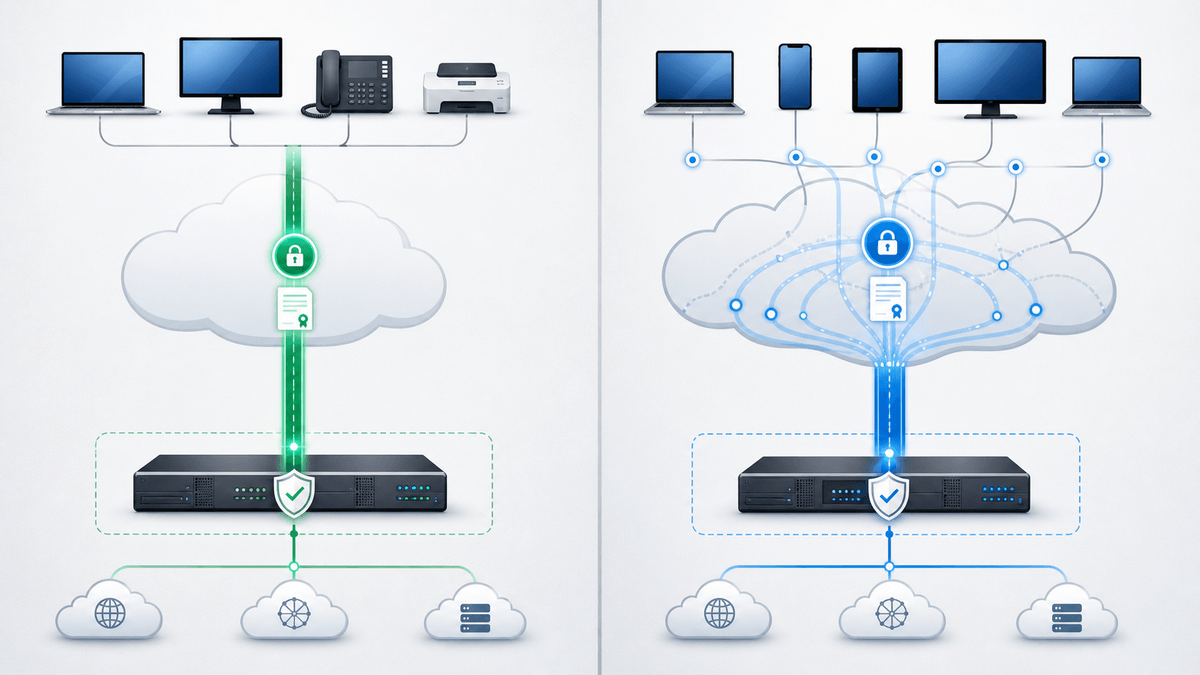
Traditional DNS queries from a client to its configured recursive resolver have often traveled without transport encryption. A device on an untrusted or compromised path could observe the requested domain names or interfere with the exchange. DNS over TLS and DNS over HTTPS were standardized to provide protected transports for DNS messages between participating clients and resolvers.
RFC 7858 specifies DNS over TLS. A client establishes a TCP connection to the resolver, performs a TLS handshake, authenticates the intended service according to its privacy profile, and sends DNS messages through the protected channel. The default well-known port is 853.
RFC 8484 specifies DNS over HTTPS. DNS requests and responses are carried using HTTPS, commonly over port 443. The protocol uses the security and application semantics of HTTP, and implementations can use HTTP features such as request methods, caching rules, multiplexing, and connection reuse.
In both cases, the encrypted channel normally covers the path from the client to the recursive resolver. The recursive resolver still has to answer from cache or communicate with other DNS infrastructure. Encryption of this first hop does not by itself prove that a DNS answer is authentic, block malicious domains, or encrypt every later step in resolution.
DNS over TLS vs DNS over HTTPS at a Glance
| Decision area | DNS over TLS | DNS over HTTPS |
|---|---|---|
| Standard | RFC 7858 | RFC 8484 |
| Normal transport | DNS messages over a dedicated TLS connection | DNS messages carried as HTTPS requests and responses |
| Default port | TCP 853 | TCP 443 through HTTPS |
| Network identification | Dedicated port makes the transport easier to identify and route by policy | Shares HTTPS transport, so policy needs resolver, endpoint, destination, or application context |
| Endpoint fit | Often suits operating-system or network-managed resolver configurations | Commonly available in browsers, applications, mobile platforms, and managed operating systems |
| Enterprise risk | Unauthorized external DoT is usually visible by destination and port but still bypasses internal resolution | Application-selected external DoH can blend with web traffic and create split DNS behavior |
| Best decision basis | Choose when a distinct DNS transport improves managed network policy and the endpoint supports it | Choose when HTTPS compatibility and application or platform support are important and resolver use can be governed |
Privacy Is Similar, but Operational Visibility Is Not
Both transports can prevent passive observers on the client-to-resolver path from reading DNS messages. Both depend on correct TLS configuration, certificate validation, supported cryptography, and an authenticated destination. Neither prevents the selected resolver from seeing the queries it processes. Resolver trust, logging policy, retention, and jurisdiction remain part of the privacy decision.
The operational difference begins at the network boundary. DoT's dedicated port gives infrastructure teams an obvious policy point. They can permit managed endpoints to reach authorized resolvers and investigate unexpected port 853 destinations. DoH uses the default HTTPS port and may share connections and infrastructure with ordinary web traffic. Blocking all port 443 traffic is not realistic, so control depends more heavily on endpoint management, known resolver policy, destination intelligence, and application configuration.
This does not make DoH inherently unsuitable for enterprises. It means the organization must deploy it deliberately. A managed DoH service can preserve privacy and internal policy. Unmanaged DoH can produce a different resolver path for one browser or application than the path used by the operating system, command-line tools, and other services.
Encrypted DNS Does Not Replace DNSSEC or Protective Policy
Transport encryption and DNSSEC address different problems. DoT and DoH protect the channel between a client and resolver. DNSSEC allows validating resolvers to verify signatures associated with DNS data and detect certain forms of tampering. An encrypted connection to a resolver does not guarantee that the data is signed or correctly validated.
Likewise, encryption does not decide whether a domain should be allowed. Enterprises may still need domain policy, threat intelligence, access controls, rate limits, anomaly monitoring, and incident logs. ZDNS describes DoT/DoH and DNSSEC alongside protocol security and access-control capabilities rather than treating encryption as the entire security model.
A sound architecture therefore asks four separate questions:
- Is the client communicating with an authorized resolver?
- Is the client-to-resolver channel encrypted and authenticated?
- Does the resolver validate and apply the required DNS policy?
- Can operations teams observe health, diagnose failures, and retain appropriate evidence?
Performance Depends on the Whole Resolver Path

Both protocols add connection establishment and cryptographic work compared with a simple unencrypted UDP exchange. In practice, persistent connections, session resumption, multiplexing, local resolver placement, caching, and network latency can matter more than the protocol label alone.
DoH can benefit from mature HTTPS infrastructure and HTTP multiplexing. It can also compete with application traffic or introduce proxy behavior that complicates diagnosis. DoT has simpler DNS-specific transport semantics, but a poorly placed resolver or frequent connection churn can still create latency. Teams should test cold connections, warm connections, cache hits, cache misses, failure recovery, and peak concurrency.
Do not judge success only by average query time. Measure tail latency, handshake failures, certificate errors, resolver failover, timeout behavior, and the impact on application startup. Compare managed encrypted DNS with the existing resolver path from representative offices, branches, VPNs, wireless networks, and mobile endpoints.
Choose an Enterprise Operating Model Before a Protocol
The first design decision is which resolvers are authorized. The second is how endpoints learn and enforce that choice. Only then should teams choose DoT, DoH, or a supported combination for each endpoint group.
Many organizations will use more than one model. Managed workstations may receive an operating-system resolver policy. Browsers may be configured to follow the system resolver or use an approved DoH endpoint. Mobile platforms may require a different management profile. Network infrastructure can use traditional DNS or DoT according to platform support. Guest networks may have privacy requirements that differ from internal application zones.
The design should prevent accidental split behavior. A device that resolves an internal name through the corporate resolver but sends public names through an application-selected resolver can generate inconsistent answers, bypass policy, and confuse troubleshooting. The organization should document expected behavior for internal zones, public zones, VPN connections, captive portals, and failure conditions.
A Controlled Rollout Sequence
A staged implementation reduces surprises. Start with a resolver and endpoint inventory. Identify which clients support DoT, DoH, discovery mechanisms, policy controls, certificate trust, and fallback configuration. Document applications that embed their own DNS behavior.
Then build the authorized resolver service and confirm capacity, high availability, certificate lifecycle, logging, and policy. ZDNS DNS resolution and monitoring can be evaluated where organizations need encrypted DNS, access controls, forwarding choices, dual-stack behavior, and resilience in one operational platform.
Roll out by endpoint cohort and validate:
- The endpoint uses the intended resolver and transport.
- Internal and public names return the expected answers.
- Certificate validation failures do not silently force an unapproved path.
- DNS policy and logging remain available at the managed resolver.
- Resolver failover behaves predictably during an outage test.
- Help-desk and network teams can distinguish DNS, TLS, HTTP, and application failures.
Finally, monitor unauthorized resolver destinations and configuration drift. Policy should be reviewed as browser, operating-system, and application behavior evolves. Encrypted DNS governance is an operating practice, not a one-time firewall change.
Conclusion
DNS over TLS and DNS over HTTPS both improve privacy on the client-to-resolver path. DoT offers a distinct DNS transport that is easier to identify by port. DoH uses HTTPS, which improves compatibility in many environments but requires more contextual control to prevent unmanaged resolver paths.
The right enterprise answer can be DoT, DoH, or both, provided the organization controls resolver selection, validates the encrypted service, preserves DNS policy, and maintains operational evidence. Begin with the operating model, test real endpoint behavior, and treat encryption as one layer of a broader DNS security and resilience architecture.