
What Should You Know First?
- A reservation and a manually configured static IP can both remain stable, but control lives in different places.
- Use reservations when centralized configuration and easy replacement matter; use manual static addressing when the device must start without DHCP.
- Never let an undocumented static address overlap a dynamic allocation range.
- ZDNS DHCP and IPAM keep reserved, bound, dynamic, and static address ownership visible across the lifecycle.
The decision is not "dynamic versus permanent." It is a dependency and ownership decision.
The difference between a DHCP reservation and a static IP is not simply whether an address stays the same. Both approaches can give a device a stable address, but they place control in different locations. A DHCP reservation keeps the assignment in a centralized service and associates it with a client identifier such as a MAC address. A static IP is configured on the endpoint itself. That distinction affects onboarding, replacement, troubleshooting, failover, DNS updates, and the accuracy of the organization's address records.
ZDNS DHCP supports static address pools, bound-type allocation, dynamic-first and fixed-after allocation, standard and custom options, DDNS, and endpoint identity attributes. ZDNS IPAM supports dynamic, static, and bound address allocation together with planning, discovery, and full lifecycle history. The practical goal is not to declare one method universally better. It is to choose the model that matches each device's boot requirements, management ownership, mobility, and dependence on DHCP.
What Is the Difference Between a Reservation and a Static IP?
With a reservation, the endpoint still participates in DHCP. It asks for configuration, and the DHCP service recognizes the client identifier and returns the designated address. The same exchange can also deliver the subnet mask, gateway, DNS servers, domain name, and other options. Operations can change those parameters centrally. The endpoint normally does not need a technician to edit its local network settings.
With a static IP, the endpoint starts with an address already configured in its operating system, firmware, or management interface. It can communicate even if DHCP is unavailable, provided the rest of the network path is working. However, changes to the address, gateway, or DNS settings usually require device-level access or another endpoint-management mechanism. IPAM must record that assignment because the DHCP server will not create a lease showing that the address is in use.
How Does a DHCP Reservation Work?
A reservation binds a stable address to a durable client identity. Depending on the platform and client, that identity may be a hardware address or another DHCP client identifier. Consistency matters: if a device changes interfaces, uses a randomized MAC address, or sends a different client identifier after an upgrade, the reservation may no longer match. The server can then offer a dynamic address or refuse the expected assignment, even though the original reservation still exists.
Reservations work well for printers, access points, cameras, management controllers, and other devices that need predictable addressing but can use DHCP. They preserve centralized configuration and can simplify replacement: update the binding or identifier in one place rather than manually editing every network parameter on the endpoint. ZDNS DHCP endpoint fingerprint attributes and IP, MAC, and hostname visibility support verification that the expected device received the intended address.
How Does a Manually Configured Static IP Work?
A true static IP is independent of the lease process. This is useful for infrastructure that must initialize before DHCP is available or whose function includes providing DHCP itself. Routers, firewalls, core switches, hypervisor management interfaces, storage controllers, and DHCP servers may require deliberate static configuration. The address must be excluded from every overlapping dynamic pool and documented with its subnet, gateway, DNS settings, owner, device, and purpose.
Static configuration transfers more lifecycle work to operations. When a DNS resolver changes, a gateway moves, or a subnet is renumbered, each endpoint must receive the new setting. Devices can be forgotten, duplicated, or moved without updating the address record. ZDNS IPAM discovery and lifecycle history help compare the planned static assignment with observed use. That visibility is essential because a static endpoint can remain active even when no DHCP lease or reservation describes it.
Which Addressing Model Fits Each Device?
Choose a DHCP reservation when the device supports reliable DHCP, needs a stable address, and benefits from centrally delivered options. Choose a static IP when the device must operate without DHCP, participates in the network's foundational control plane, or has a vendor-supported design that requires local configuration. Keep both categories in IPAM. A reservation is not permission to forget the device, and a static address is not permission to bypass centralized address planning.
Make the decision per interface rather than per device label. A single appliance can legitimately use a reservation for its production interface and a static address for out-of-band management. Recording that distinction prevents teams from applying one broad rule to every interface and makes replacement, recovery, and DNS maintenance easier to plan.
- Use reservations for centrally managed printers, access points, cameras, and appliances that reliably identify themselves.
- Use static addressing for DHCP servers, core gateways, and infrastructure that must start before DHCP is reachable.
- Avoid reservations for clients that routinely randomize identifiers unless the identity method is controlled.
- Avoid manually configured static addresses inside a dynamic pool.
- Record owner, purpose, location, and lifecycle state for both models in IPAM.
- Define how replacement hardware inherits or retires the old assignment.
| Decision factor | DHCP reservation | Manual static IP |
|---|---|---|
| Control location | Central DHCP service | Endpoint or device configuration |
| Starts when DHCP is unavailable | Only while a valid client lease remains usable | Yes, if the local network path is available |
| Gateway or DNS change | Delivered centrally at renewal | Requires device-side change or another management system |
| Device replacement | Update the client identifier or binding | Configure the replacement device manually |
| Best fit | Printers, cameras, APs, managed endpoints | Gateways, core infrastructure, bootstrap-critical services |
Microsoft defines a reservation as a preset address delivered by DHCP to a network interface. RFC 2131 identifies a lease using the client identifier or hardware address together with the assigned address. DHCPv4 also relies on UDP ports 67 and 68. These details explain the dependency: the endpoint must still reach DHCP and present the expected identity.
Where Does Each Addressing Model Commonly Fail?
Reservations fail when identity assumptions fail. A replaced network card, privacy feature, virtual machine clone, or incorrectly entered identifier can prevent a match. Duplicate reservations or conflicting bindings can also create confusing results. Troubleshooting should verify the identifier sent by the client, the reservation record, the scope, and the actual DHCPACK. Looking only at the address printed on a device label is not enough.
Static IPs fail through overlap and drift. An administrator may select an address that looks unused but is inside a DHCP range, reserved for another site, or temporarily offline. A subnet change may update the routing infrastructure while leaving a camera or controller with an old gateway. DNS records can continue pointing to an address after the device moves. IPAM planning, discovery, and history reduce these risks by making static use visible alongside dynamic allocation.
How Do ZDNS DHCP and IPAM Manage Stable Addresses?
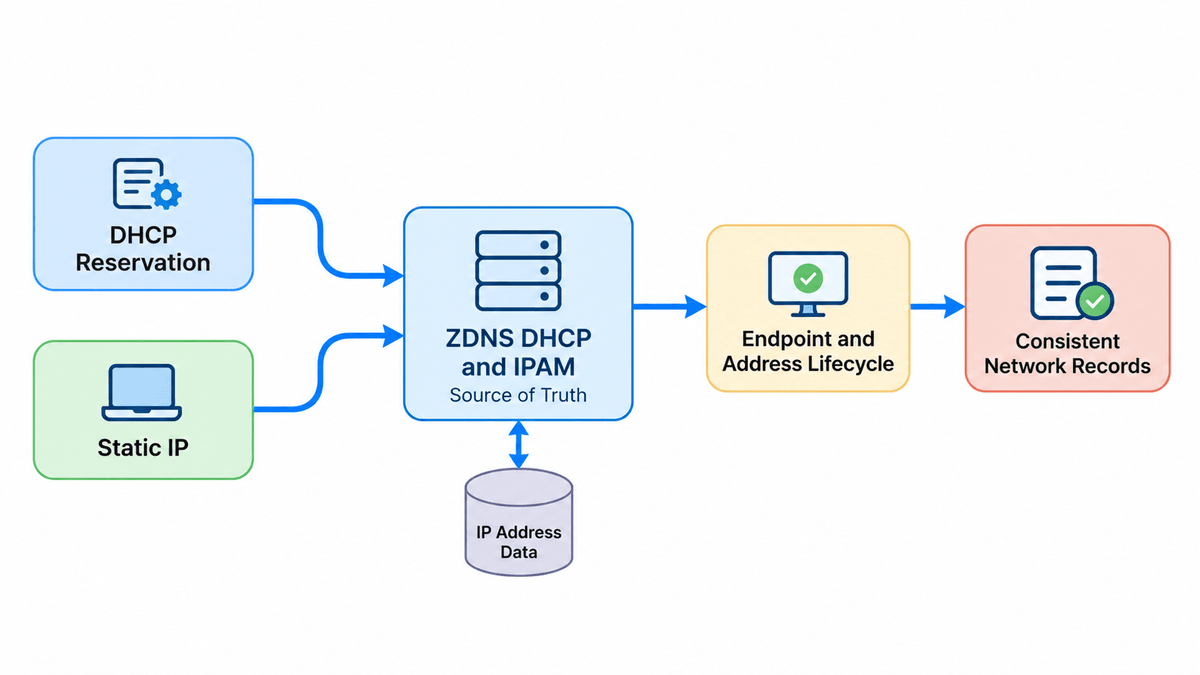
ZDNS supports a useful middle path for devices that begin dynamically and later need stable addressing. Dynamic-first and fixed-after allocation lets operations observe a real device and its identity before fixing the assignment. That can reduce data-entry errors compared with prebuilding a reservation from an unverified spreadsheet. Bound-type allocation and endpoint attributes keep the address associated with meaningful device context.
The DHCP and IPAM records should form one operating view. DHCP shows leases, assignments, transactions, and delivered options. IPAM shows the address plan, ownership, discovered state, and historical changes. ZDNS DNS becomes relevant when DDNS is used to keep names aligned with dynamic or reserved addresses. The three services should agree on which device owns the address and how other systems reach it.
Should Branch Printers and Access Points Use Reservations?
A branch has dozens of printers and wireless access points. Technicians previously configured static addresses locally, producing inconsistent gateways and undocumented overlaps after subnet changes. The devices support DHCP and expose stable identifiers, so the team moves them to reservations. ZDNS DHCP delivers the address and standard network options, while ZDNS IPAM records the device, owner, and location. Replacement hardware is handled by updating the reservation identity through a controlled process.
The change does not eliminate all static addressing. The branch router, DHCP service interface, and core management endpoints remain static because they must operate independently of the local lease service. Those assignments are moved outside the dynamic pool and documented in IPAM. The mixed model is intentional: reservations reduce endpoint configuration work, while a small static foundation preserves bootstrap independence.
Should a Multi-Interface Server Depend on DHCP?
A data center server has production, backup, and out-of-band management interfaces. The production address is delivered through a reservation because the orchestration workflow can reproduce the binding and options. The out-of-band controller uses a static address so operators can reach it during a DHCP outage. The backup interface follows a separate subnet policy. Each address is linked to the same asset in IPAM rather than being managed as an unrelated line in a spreadsheet.
During hardware replacement, the team verifies which identifiers change, removes obsolete bindings, and confirms forward and reverse DNS behavior. This avoids a common mistake: transferring a server name while leaving an old reservation active. ZDNS lifecycle history gives operations a record of the previous and current assignments, improving both troubleshooting and capacity accuracy.
How Do You Migrate Static Devices Safely?
- Inventory the current address, device identity, owner, and physical or virtual location.
- Confirm the address is outside conflicting DHCP ranges or other static use.
- Decide whether the device can depend on DHCP during boot and recovery.
- Verify the exact client identifier before creating a reservation.
- Test gateway, DNS, DDNS, monitoring, and application reachability after the change.
- Remove the old local static configuration or obsolete reservation.
- Record the final state and replacement procedure in IPAM.
The best choice in the DHCP reservation versus static IP decision is the one that makes ownership and recovery clearer. Reservations centralize stable addressing for suitable clients; static configuration protects infrastructure that cannot depend on DHCP. ZDNS provides DHCP and IPAM capabilities for managing both models as one address lifecycle, reducing the manual gaps that lead to conflicts, stale records, and difficult migrations.
What Do Network Teams Ask About Reservations and Static IPs?
Is a DHCP reservation the same as a static IP?
Both can give a device a repeatable address, but they are not the same control. A reservation is stored on the DHCP service and delivered during a lease exchange. A manually configured static IP is stored on the endpoint. That distinction changes availability dependencies, replacement work, option delivery, and troubleshooting evidence.
Should printers use reservations or manual static addresses?
Reservations are usually easier when printers support DHCP reliably because DNS, gateway, and other options stay centrally managed. A manual static address may fit an isolated or bootstrap-sensitive device. Whichever model is chosen, record the address in IPAM and keep it outside conflicting dynamic allocation so replacement does not create ambiguity.
What happens to a reservation when the MAC address changes?
The reservation may stop matching, and the device can receive a different dynamic address or fail to receive the expected one. Interface replacement, virtualization, docking, and MAC randomization can all change client identity. Update the binding through a controlled change and verify the resulting lease, DNS record, and IPAM ownership before closing the task.
Can I configure both a reservation and the same static IP?
It can be used as documentation or fallback in some environments, but it creates two control points and must be governed carefully. The DHCP server cannot configure an endpoint that never asks for a lease. A cleaner design normally separates manual static ranges from dynamic pools and records both categories authoritatively in IPAM.
Which devices should not depend on DHCP?
Devices required to restore DHCP itself or basic network reachability deserve special review. Core gateways, selected out-of-band management, and bootstrap-critical infrastructure may need deliberate static configuration. The decision depends on failure sequencing, not a blanket device label. Document who owns the address, gateway, DNS settings, and recovery procedure.