
When a brand or registry team evaluates secure DNS hosting for a top-level domain, it needs to know who publishes the zone, who controls DNSSEC keys and delegation changes, and how the parties will recover from a failed change. Those responsibilities can span the registry operator, its technical service providers, and the people authorized to request changes at the parent. Review the boundaries before choosing a provider or agreeing to a transition plan.
This checklist is for teams operating or planning a public TLD. It focuses on authoritative DNS, the service that publishes records for the zone. Employee DNS filtering and recursive resolver procurement involve a different set of controls and owners.
Identify who controls each part of the service
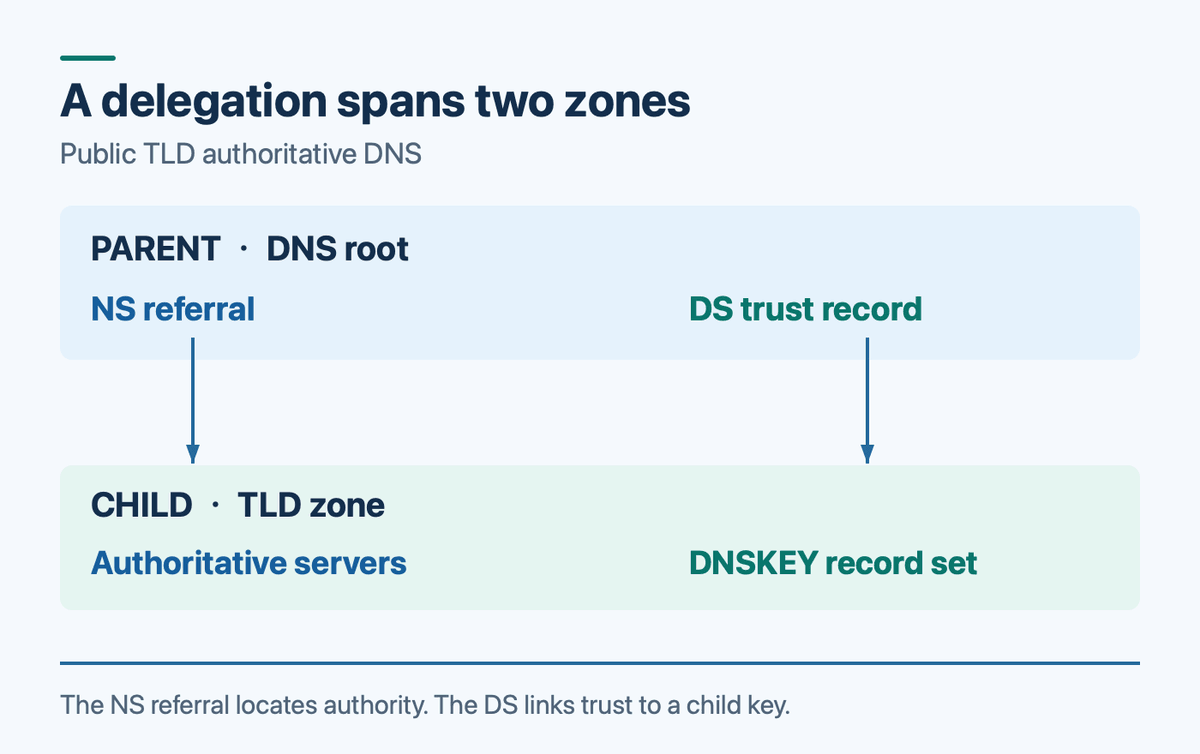
Write down the exact zone and the organization accountable for it. For a TLD, the parent is the DNS root. For a second-level domain delegated directly under a TLD, the parent is that TLD. In either case, delegation and the operation of the delegated zone are separate responsibilities. A change ticket should identify which organization can request a parent-side update, who can approve it, and which provider implements changes to the authoritative service.
The public record for .fans illustrates the distinction. IANA lists ZDNS International Limited as the manager and publishes the delegation's name servers and DNSSEC information. Its entry also lists a separate technical contact organization. A public listing can establish these published roles and delegation facts. The registry's operating agreement and runbooks are needed to establish who can change records, handle keys, and respond to an incident.
Ask for a named owner, backup, and escalation route for each of these tasks.
Zone publishing — Change approval, expected publication time, and a way to compare answers across authoritative instances
Parent delegation — Authorized requester, verification steps, and an emergency escalation path
DNSSEC operations — Key custody, rollover responsibilities, and coordination of parent DS changes
Availability and incident response — Monitoring scope, incident notification commitments, and evidence from a recovery exercise
Some responsibilities can remain with the registry even when a provider performs the technical work. Identify who makes the decision to revert a change as well as who can carry it out.
Verify that DNSSEC remains valid through a change
DNSSEC enables validating resolvers to authenticate signed DNS data through a chain of trust. During a hosting change, the parent DS record and the child zone's DNSKEY records must support a valid chain. A mismatch can cause validating resolvers to reject answers even when the authoritative servers respond.
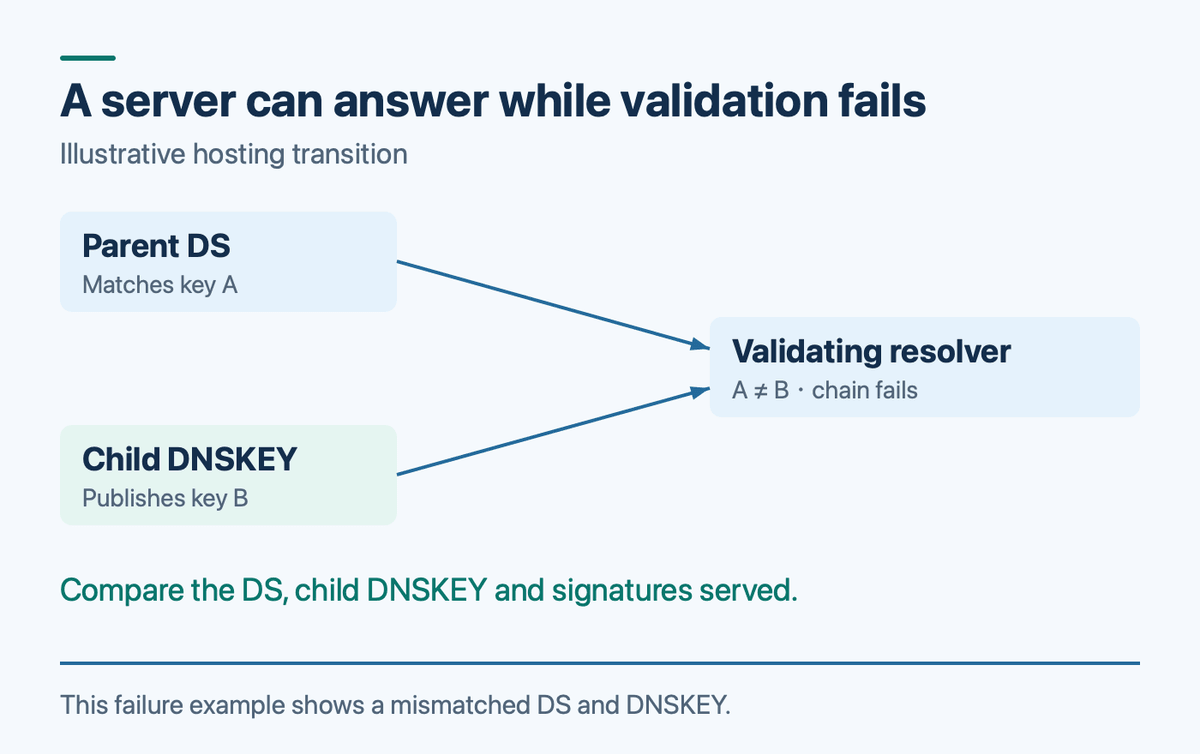
Ask for a worked example of a planned key rollover and a provider transition. The example should show which keys and DS records are published at each stage, which party authorizes changes, and what observations allow the team to proceed. Where the procedure depends on an earlier record expiring from caches, include the relevant TTLs and explain how the team will treat unusual cache behavior during verification.
Use a test or staging zone where practical. Check a normal signed response and a signed negative response for a name that does not exist. Compare answers from authoritative servers and check the result through independent validating resolvers. Decide in advance which failures pause the change and who can approve resuming it. For the mechanics of verifying a delegation or a rollback, use the ZDNS DNS zone change guide.
Separate availability claims from recovery evidence
A name-server list gives you the published delegation. To evaluate resilience, ask what dependencies the service shares across its advertised sites. Where relevant, review the underlying network, provisioning system, signing infrastructure, monitoring, and administrative access. Several servers can remain reachable while a shared publishing failure leaves them serving old data. Likewise, a control-plane outage may prevent changes while the existing zone continues to answer.
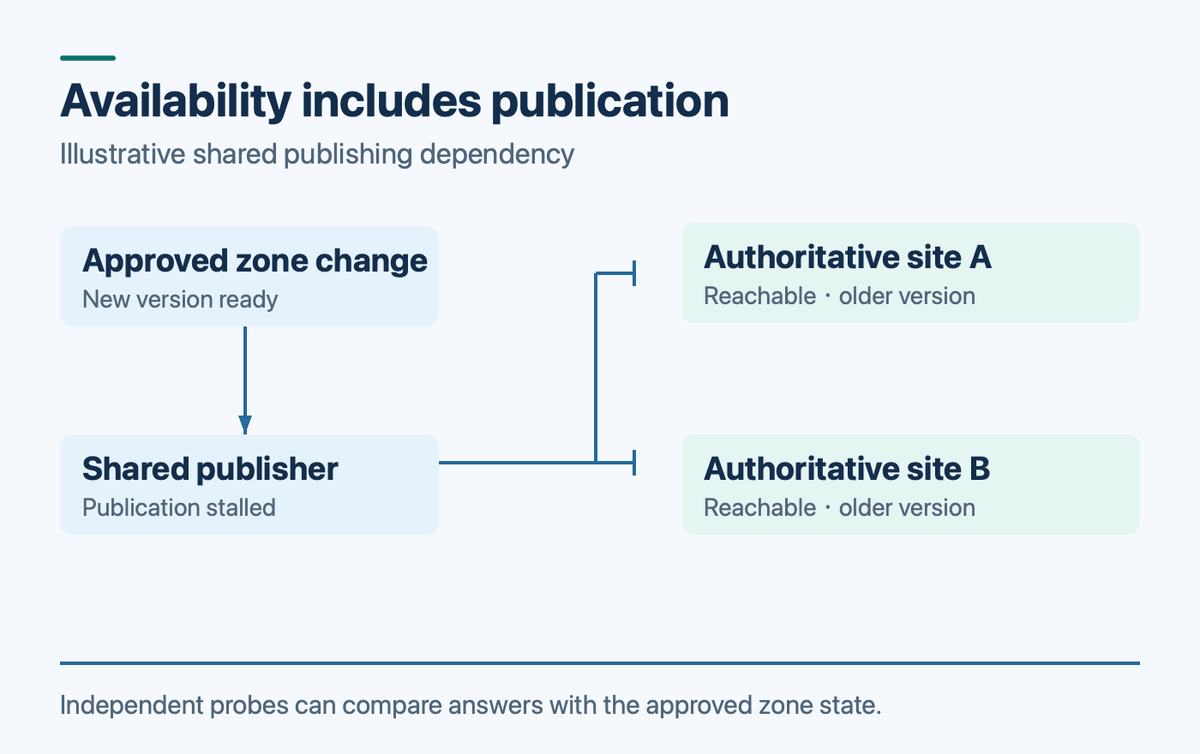
Ask the provider how it detects each condition. Monitoring can compare the expected zone state with answers from several independent networks, check that signed answers validate, and detect a stale zone serial where serial comparisons are appropriate. Useful incident evidence names the affected zone, gives a timestamp, and states which checks failed and where. The registry then has something concrete to compare with its own observations.
During procurement, request the scope of service commitments. Check whether they cover answering queries, publishing approved changes, incident notification, and restoration of the management interface. Each can have different measurement conditions. Ask for a sample report or the result of a recovery exercise so the team can see what evidence it would actually receive.
Rehearse a failed change before production
Suppose a fictional registry is moving its authoritative service while keeping the existing TLD and its delegations. The registry and both providers agree on which data will be published before the change and how updates will be handled while old and new paths coexist. The registry also records the current parent NS and DS entries and agrees who can request a change or reversal.
During the rehearsal, the new servers answer queries, but a validating resolver reports a failure. The change lead pauses the next step. The DNSSEC owner checks the parent DS, the child keys, and the signatures being served. The team records which parts of the rollout were already visible through public resolvers. This determines which recovery steps are viable while cached data remains in circulation.
The rehearsal should establish two facts. First, the registry can identify whether the failure is in publication, delegation, or validation. Second, the operators have authority and working access to restore a known-good state. If either remains uncertain, keep the production change on hold while the parties close that gap. Require evidence of successful validation and ordinary resolution from multiple vantage points before retiring the old service.
What to bring to a TLD hosting discussion
Start with a one-page description of the project. Include the proposed string or existing TLD, the registry operator and providers involved, the expected DNSSEC model, and any constraints around migration or a launch date. For an existing TLD, include public delegation information and summarize the current split of responsibilities. For a prospective TLD, list which operating roles still need an owner and which service decisions are pending.
Use that brief to ask providers for their scope in writing. Confirm which parts of the proposed service they perform directly, where another provider or the registry must act, and what evidence they supply at acceptance. A registry choosing a partner should be able to identify the person who approves each change and the measurements that show the change succeeded.
Agree on how the same evidence will be retained after acceptance. A periodic review can compare the published delegation with the registry’s approved record, identify upcoming signature or key events, and confirm that emergency contacts still have the required access. Ask for those outputs in a format the registry can retain and review independently when it changes providers or staff.
Questions TLD teams ask
Does a signed delegation establish that the service is resilient?
A signed delegation supports DNS data validation. Resilience also depends on service availability, zone publishing, monitoring, and recovery. Ask for evidence for each part of the service.
Can the registry operator and technical provider be different organizations?
Yes. Review the public delegation records to identify the listed roles, and consult the operating agreement for the current allocation of duties. Be specific about who owns key custody, publication approvals, and emergency changes.
Can every hosting change use the same rollback plan?
A plan depends on which delegation and signing changes have already taken effect, what resolvers may have cached, and whether the earlier authoritative service still has compatible data. Establish those conditions in advance and make them part of the decision to proceed.
Discuss registry and delegation requirements with ZDNS
ZDNS lists application strategy, registry support, root-zone delegation assistance, and global compliance consultation in its TLD services. Share your project brief and ask which organization would own publication, signing, and emergency changes under the proposed arrangement.